ي هذا الموقع من محافظة مسقط، تتمازج مدينة مسقط العصرية بمبانيها الحديثة مع النمط المعماري القديم للقرى العمانية الاثرية، في إطلالة على جبال الحجر. على اليسار في الجبل المقابل يمكنك مشاهدة منكشف لأفضل وأجود خامات الرخام في سلطنة عمان، نظرا لاحتواء الخامات على تركيب داخلي متراصف الطبقات بألون متعددة. وفي الاصل فإن هذه الصخور كانت طبقات من الحجر الجيري ضمن صخور الجرف القاري. وقد نشأت خامات الرخام قبل ما يقارب 90 إلى 70 مليون سنة عندما التقت صخور القشرة القارية الرسوبية بصخور القشرة المحيطية النارية، وقد تحولت صخور الحجر الجيري إلى الرخام بفعل الضغط والحرارة الشديدين اللذان صاحبا تكوّن الصخور النارية. وعلى اليمين يمكنك مشاهدة النمط المعماري العماني القديم، حيث تعتبر هذه القرى الاثرية مزارات هامة تحكي تاريخ عمان عبر العصور المختلفة، حيث كانت البيوت العمانية تبنى من الطين والصاروج (الجصّ). وقد تناقل الابناء من الآباء والأجداد هذه الحرفة التي بدأت تضمحل مع وجود مواد البناء الحديثة التي حلت تدريجيا محل الطابوق الطيني والصاروج.
The Cretaceous quartzite here originated in the time of the dinosaurs around 90 million years ago. The quartzite was originally sandstone. It changed its structure (metamorphosed) under heavy pressure when the ocean floor was pushed over oceanic sediments and the Arabian plate. This caused the quartz crystals within the sandstone to change, recrystalising to form a new rock: quartzite. The varying reddish colors in the quartzite are due to different amounts of iron oxide, while the yellow and orange are traces of other minerals. These rocks are considered to be semi-gemstones; useful for building, sculpture or jewelry.
Around 34 to 23 million years ago, this area was covered by shallow sea; an ideal environment for nummulites of the foraminifera class. These small single celled organisms have calcite shells with internal spiral coils divided into chambers.Once foraminifera die, their shells accumulate on the sea floor to form limestone.Nummulite is from the Latin meaning “little coin”; the road cutting here has exposed these fossils which are also known as “Angel’s coins”. Descendants of these now fossilized foraminifera can still be found living in today’s oceans.
Around 34 to 23 million years ago, this part of Oman was much lower than it is today and covered by a shallow sea. The Mid Tertiary limestone originally formed in horizontal layers on the sea floor. Over time the rock layers became slightly tilted. The land was later uplifted, then in the last 2 million years, a large wadi deposited layers of gravels of various sizes and of different origins, burying the marine formation. These gravels became cemented together to form a rock called conglomerate.Here, as there is a gap in time between the deposition of the limestone and conglomerate, the meeting of the two layers of rock is called an unconformity.
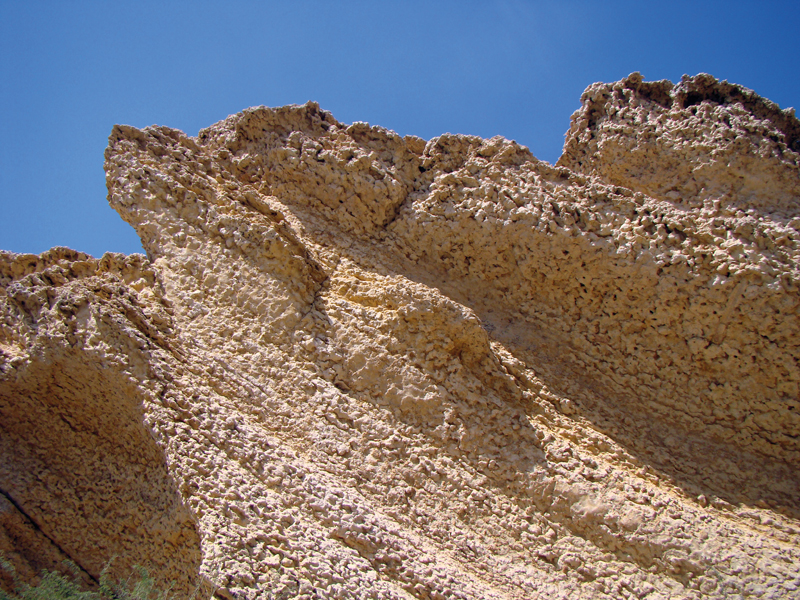
The yellow-brown rock on the banks of Wadi Al Khawd opposite was originally the sea floor. Between 55 to 34 million years ago (Eocene Age) the sea was rich in marine life and the remains of marine creatures like sea slugs, clams and coral settled in sedimentary layers. Within these layers the bones of the harder shelled animals formed jumbled groups with empty spaces as seen in the fossils. Over time, the limestone has been lifted above sea level and exposed the nodular texture of these lumpy masses of hard shells.