In this part of the city, modern Muscat meets old traditional buildings at the foot of the Hajar Mountains. The light colored rock which you find at this location is considered to be the best marble deposit in Oman due to its attractive banding. Originally the rock was limestone laid down as part of a coral reef.The marble developed during the late cretaceous, around 90 to 70 million years ago. At this time the limestone was changed or metamorphosed under huge pressure from overlying hot and heavy Ophiolite rocks.The old building next to the car park is part of an old village. At one time most buildings in Oman were hand made from mud bricks and often covered by sarooj, a hard cement like plaster. The art of building using this method was passed on orally from father to son. These days with the availability of modern stronger building materials the incentive to use these traditional high maintenance and time consuming methods is declining.
The Ayn Al Hammam hot spring is situated at a huge fault structure, separating Triassic dolomite (sedimentary rocks) from ophiolite (igneous rocks). They were brought together in a huge tectonic movement called obduction. It appeared when the ocean floor in front of Oman’s coast was pushed above the Arabian continent, forming the Oman Mountains.
Most of the hot springs in Oman (Kesfeh in Rustaq and Thwara in Nakhal) are located along this major fault.
The hot water of this spring has traveled far from within the ground where the temperature is a lot higher. Here the heated water is rising from beneath the ophiolite where it is in contact with the dolomite.
As the water traveled through the dolomite it dissolved calcite from the rock. On the surface the calcite has recrystalised along the hot water aqueduct.
At around 65o Celsius the Ayn Al Hammam spring is said to be the hottest spring of Oman. It is considered to have healing properties due to its high mineral content.
The Cretaceous quartzite here originated in the time of the dinosaurs around 90 million years ago. The quartzite was originally sandstone. It changed its structure (metamorphosed) under heavy pressure when the ocean floor was pushed over oceanic sediments and the Arabian plate. This caused the quartz crystals within the sandstone to change, recrystalising to form a new rock: quartzite. The varying reddish colors in the quartzite are due to different amounts of iron oxide, while the yellow and orange are traces of other minerals. These rocks are considered to be semi-gemstones; useful for building, sculpture or jewelry.
Around 34 to 23 million years ago, this area was covered by shallow sea; an ideal environment for nummulites of the foraminifera class. These small single celled organisms have calcite shells with internal spiral coils divided into chambers.Once foraminifera die, their shells accumulate on the sea floor to form limestone.Nummulite is from the Latin meaning “little coin”; the road cutting here has exposed these fossils which are also known as “Angel’s coins”. Descendants of these now fossilized foraminifera can still be found living in today’s oceans.
Around 34 to 23 million years ago, this part of Oman was much lower than it is today and covered by a shallow sea. The Mid Tertiary limestone originally formed in horizontal layers on the sea floor. Over time the rock layers became slightly tilted. The land was later uplifted, then in the last 2 million years, a large wadi deposited layers of gravels of various sizes and of different origins, burying the marine formation. These gravels became cemented together to form a rock called conglomerate.Here, as there is a gap in time between the deposition of the limestone and conglomerate, the meeting of the two layers of rock is called an unconformity.
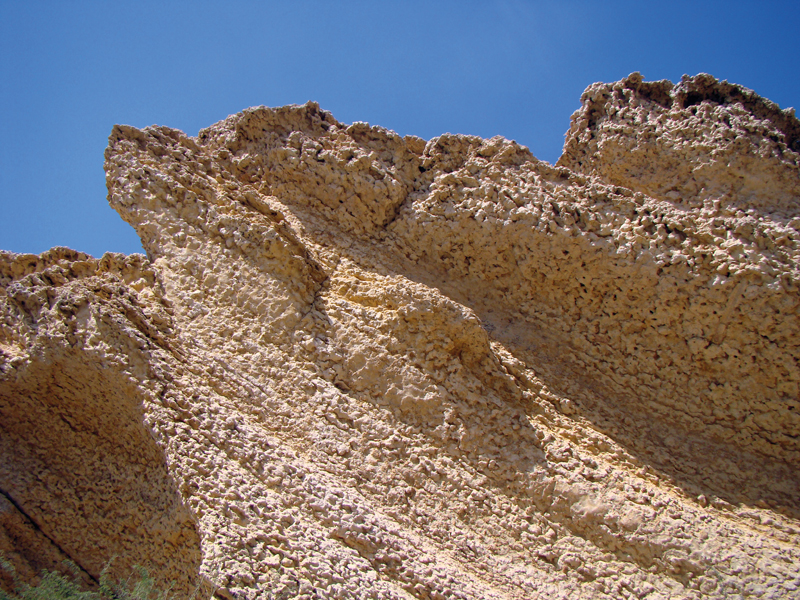
The yellow-brown rock on the banks of Wadi Al Khawd opposite was originally the sea floor. Between 55 to 34 million years ago (Eocene Age) the sea was rich in marine life and the remains of marine creatures like sea slugs, clams and coral settled in sedimentary layers. Within these layers the bones of the harder shelled animals formed jumbled groups with empty spaces as seen in the fossils. Over time, the limestone has been lifted above sea level and exposed the nodular texture of these lumpy masses of hard shells.